

Taming the Sky
A Review Essay of Untethered Sky by Fonda Lee

‘Zahra was her name.’
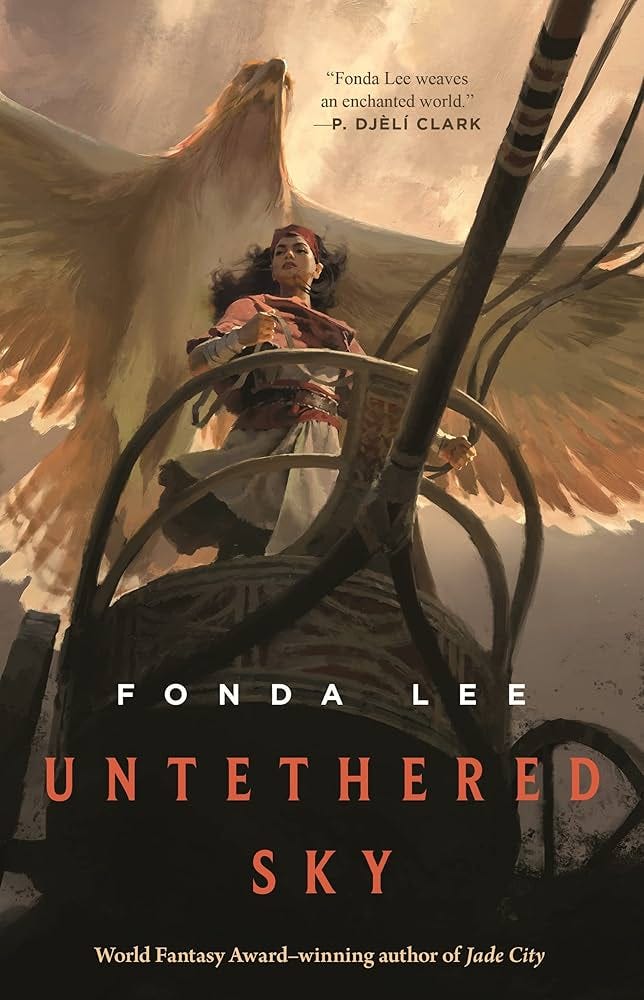
This is the first line of Fonda Lee’s fantasy novella Untethered Sky. We follow a ruhker (a giant bird trainer who risks her life to hunt wild animals with her roc) and take a look at her life, her past, and the world where she lives and survives.
Have you considered using other cultures as a base for your fantasy world? Did you notice how your own culture and influences seep into your writing? Fonda Lee was obviously influenced by Arab culture when she wrote this novella. Her use of Arabic names and the race of the giant birds ‘roc’, after the mythological bird described in The Arabian Nights makes it obvious. I really like it when writers use names from their own or other cultures. It feels like modern writers are leaning towards exceptional and weird names with no reference to something specific. I think that this technique brings depth to the world without doing intense world-building in your novel because readers will automatically relate to that culture without you having to explain it.
You might wonder, since this is a fantasy world, how can real-life cultures influence my fiction? It can in various ways. For instance, the Arab world is associated with deserts. An example that comes to mind is Dune by Frank Herbert where he created a desert planet. His use of the Arabic language makes it even more subtle. Lee is influenced by names and animals more than atmosphere, but the effects are the same; we get to see a world that feels real and alive.
Another interesting aspect of her writing is her (as I call it) easy-going language. You may ask me, what does that mean? It means her prose flows easily and naturally without any decorations or poetic language. Is that a good thing? I say it depends. Lee tries to focus on the plot and story itself rather than presenting metaphors. Look at this example: ‘Zahra stepped calmly into the mews pen without coaxing. Babak and the gathered ruhkers watching from behind the bars nodded approvingly. The fledgling hadn’t hunched in the crate in fear, nor exploded out of it screaming with rage. She was healthy, calm, and brave—the most anyone could ask for.’ See how informative and descriptive that paragraph is? Lee isn’t giving us images; she gives us information. The story flows from point A to point B.
So, does that mean we don’t get internal thoughts and feelings in the novella? We actually do! Having a straightforward writing style doesn’t mean you only present the plot. Characters are as important as the story itself. Look at this example: ‘His expression suggested he didn’t think I was worthy of the roc he’d risked his life to bring to the mews.’ Lee uses observation in order for us to see other characters’ inner thoughts and feelings. The story is told from her protagonist’s perspective (Ester), and we get to feel and observe everything she does. It is a character-driven narrative that focuses on both her character and the story itself.
Looking at the structure of the novella, I noticed how Lee uses flashbacks to introduce Ester’s past. She separates these chapters by using three centred stars; they are integrated in the narrative. We don’t get long backstory all at once; we see glimpses of her past which is a very good technique for keeping the story going. Some writers tend to use epilogues to introduce the history of the world or characters. I think this is a bad idea. Readers like to get to know your world as they read the story. Dumping historical records of the fictional world alongside characters’ backstory will bore them if there is no story there yet. I always suggest that writers start with an event and build up the world and any important information from there; it will keep the reader interested and engaged with your story.
However, there is one point that felt underdeveloped in Ester’s past; her trauma. We get to see what happened to her family but we don’t really see the effect it had on her. Lee didn’t focus on this sensitive theme, which is a weak point in her novella. A person with a traumatised past should act differently from other people or at least feel affected by it. The effect felt minimal to me; she only leaves everything behind (even though she acts on it at the end), which felt shallow and unconvincing. I suggest that writers focus on doing research before committing to such subjects. Readers will notice when writers haven’t done their research and present a character that doesn’t feel real.
One last note about the title. I really liked the idea of foreshadowing the ending in her title. This creative approach makes her novella more satisfying; she pulls it off nicely. I won’t spoil the ending, but I would really recommend that you read it and judge for yourself.
Therefore, should you read Untethered Sky? Is it worth your time? I say if you are looking for an easy read; a light story that you can finish quickly; a fast-paced narrative and plot with no purple prose or decorative language, then this story is for you.
My rating for Untethered Sky is: 4 Stars.
P.S: Did you know that plot-driven stories are in demand as much as character-driven ones? The use of a combination of both will make your story shine.
"I always suggest that writers start with an event and build up the world and any important information from there; it will keep the reader interested and engaged with your story."
I really liked this because it highlights one of the strongest principles of storytelling: letting the world unfold naturally instead of overwhelming the reader with exposition. Rather than beginning with long explanations about history or lore, you emphasize that stories should first give readers a reason to care. Once they're emotionally invested, they'll naturally want to learn more about the world. It's practical advice that's easy for writers to apply, and it shows a clear understanding of how pacing and curiosity work together to keep readers engaged. I also appreciated that you explained why this approach is effective instead of simply stating it as a rule, which made the analysis feel thoughtful and convincing.
I think sometimes I worry about what elements I add into my stories from cultures that are not my own. Sometimes it's hard to know where the line is between appreciation and appropriation. My own culture doesn't tend to lend itself very well to imaginative settings.