

When Science Meets Madness
A Review Essay of At the Mountains of Madness by H. P. Lovecraft

‘I am forced into speech because men of science have refused to follow my advice without knowing why.’
Have you ever wondered if a science report could be turned into a story? In At the Mountains of Madness Lovecraft pulls us into a world where a group of scientists travel to Antarctica on an expedition to explore the vast snow-covered mountains. It is a science fiction horror where the narrative is a mix of a report and a personal story narrated in the first person.
You might think: a report might be a boring way to narrate such a story. I have to agree to some extent. However, his use of this particular style makes his story feel almost real. While reading, you get the sense of reading something like a news report because of his geological and academic terms. It sounds convincingly real.
Lovecraft's sophisticated vocabulary makes reading this story a challenge even for native speakers. I can only imagine the amount of research he did in order to write this novella (especially during his time where there was no Internet in 1931). However, having all of these scientific terms makes his characters feel like real scientists. Furthermore, Antarctica's description feels menacing; the atmosphere, the cold, the vastness and emptiness make this more of a psychological horror than a monstrous one.
You might wonder: should my story do the same as Lovecraft? Do I need to use academic terms if I am writing science fiction? I would say: it depends on your story and what feeling you want the reader to experience. Do you want something entertaining that would pull the reader into your world to enjoy the characters' experiences? Or do you want a world that feels lived in and the horror is the main objective of your story? If you want the former, then no; Lovecraft's style in this novella is immersive; it focuses on the world rather than characters. You almost get no conversations in the entire story. This lack of conversation and the focus on description and atmosphere makes this horror feel real.
Now, the downside of Lovecraft's style is repetitive pattern structure. In other words, you get the same-length sentences which make readers drift instead of focusing on the events. Here is an example: ‘Through the desolate summits swept ranging, intermittent gusts of the terrible antarctic wind; whose cadences sometimes held vague suggestions of a wild and half-sentient musical piping, with notes extending over a wide range, and which for some subconscious mnemonic reason seemed to me disquieting and even dimly terrible.’ Notice the rhythm of the sentences and how they carry the same "music" in them? This rhythmic narrative is poetic and it is one of the disadvantages of the story. Here is why: the author intended a horror science fiction story where it takes the shape of a report. Therefore, having a poetic, rhythmic language breaks the sense of momentum of the story. It is beautiful but gives the reader a dozing effect.
Now talking about the creatures in the novella, here is where it gets interesting. ‘The Old Ones’, as Lovecraft named them, are star-shaped creatures with high intelligence. They created another species to serve them, but they ended up rebelling against their creators. The ‘Shoggoths’ are shapeless creatures who live underwater and have many eyes and mouths. Lovecraft's description and their uniqueness is what drove me to read this story in the first place. His description is so precise and professional that you can almost see the creatures on the examination table. Take a look at this part:
‘Five slightly longer reddish tubes start from inner angles of starfish-shaped head and end in saclike swellings of same color which, upon pressure, open to bell-shaped orifices two inches maximum diameter and lined with sharp, white tooth like projections—probably mouths. All these tubes, cilia, and points of starfish head, found folded tightly down; tubes and points clinging to bulbous neck and torso. Flexibility surprising despite vast toughness. At bottom of torso, rough but dissimilarly functioning counterparts of head arrangements exist. […] Cannot yet assign positively to animal or vegetable kingdom, but odds now favor animal. […] Wing structure puzzles in view of probable marine habitat, but may have use in water navigation. Symmetry is curiously vegetable like, suggesting vegetable's essential up-and-down structure rather than animal's fore-and-aft structure. Fabulously early date of evolution.’
See how long and detailed this description is? I omitted a large part because it is so long, but you got the picture. At the Mountains of Madness carries the reader to the lab. It is like watching a movie from the scientists' perspective. You live the horror, the adventure, and the thrill of discovering a foreign species at the end of the world.
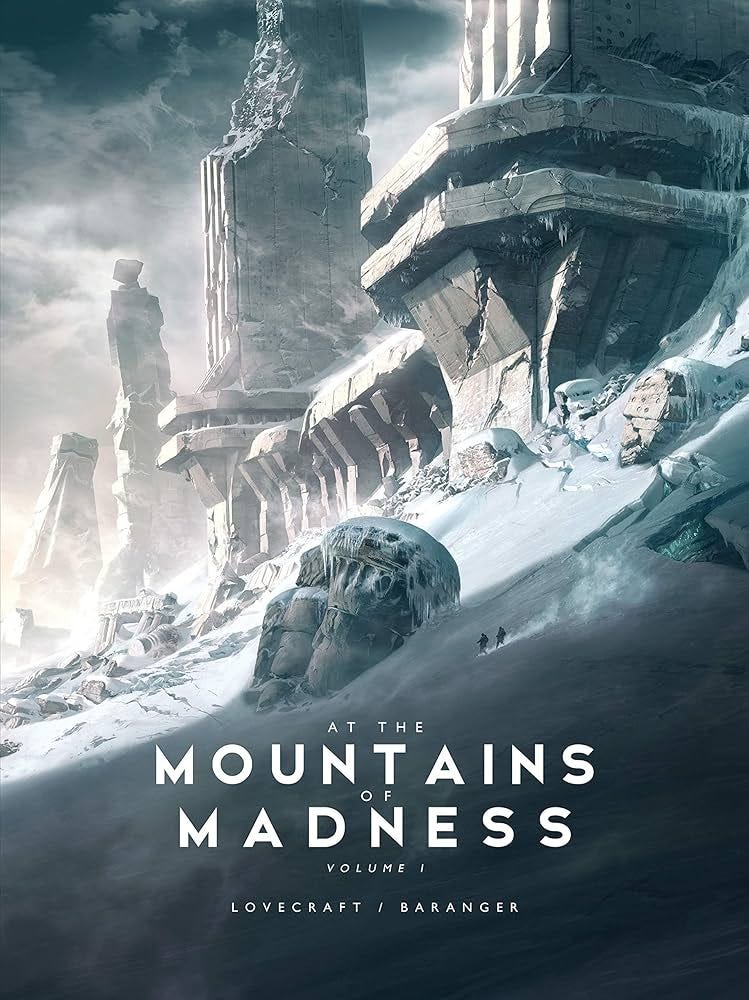
Furthermore, the city's description is so precise that we can almost see it. He writes:
‘Only the incredible, unhuman massiveness of these vast stone towers and ramparts had saved the frightful things from utter annihilation in the hundreds of thousands— perhaps millions— of years it had brooded there amidst the blasts of a bleak upland. […] The foothills were more sparsely sprinkled with grotesque stone structures, linking the terrible city to the already familiar cubes and ramparts which evidently formed its mountain outposts. […] The nameless stone labyrinth consisted, for the most part, of walls from ten to one hundred and fifty feet in ice-clear height, and of a thickness varying from five to ten feet.’
Notice how Lovecraft relies mostly on sight? While he uses other sensory details in his description, sight is the dominant one. Does that make his writing style wrong? Maybe in modern standards, but in his time, this novella became famous because of its uniqueness; it introduced a new flavour of fear.
Some writers might wonder whether, in modern writing, readers are no longer interested in long paragraphs and description with slow narrative and complex vocabulary. I say it is true to some extent, but there are still readers who enjoy such stories and find them challenging. In the end, there is no right or wrong way to write a book, there is only your version of it. This proves that following writing trends doesn't always result in becoming a published author or becoming famous.
My rating for At the Mountains of Madness is 3 stars.
Why only 3? As haunting and realistic as it was, I still found it difficult to read; the lack of dialogue, long descriptions, slow pacing, and rhythmic sentences makes it even harder to finish. Therefore, it lands in the middle of the scale.
PS: Did you know that some people have associated the AI with the Shoggoth? This is a debatable subject; tell me what do you think in the comments.
Added to my list
A really good breakdown and review of At the Mountains of Madness! I read through it for the first time earlier this month (I have been on a mission to get through all of Lovecraft's work). I thought the first half was a mastercraft in building tension. It's a real slow burn of suspense. And I appreciated the realism of the expedition. It's also very easy to see where John Carpenter got his idea for The Thing from as well. The second half, however, I felt leaned too heavily in the descriptive style. It also breaks the show dont tell rule. The narrator spends chapter after chapter describing the architecture of the ancient city with a very limited vocabulary. The amount of times the word "decadent" is used is quite extraordinary. In a very non-Lovecraft way, he spends ages telling the reader all about this ancient society of the Old Ones rather than exploring the horror of the unknown. And we are supposed to believe that the narrator learned all this from some wall markings? All the horror was snuffed out when I learned all about this society and their customs for like three chapters straight. By the time some actual action happens, I was quite checked out! Reading your breakdown certainly gives it a fresh perspective. Might have to give this one another read...