

Letters Across Time
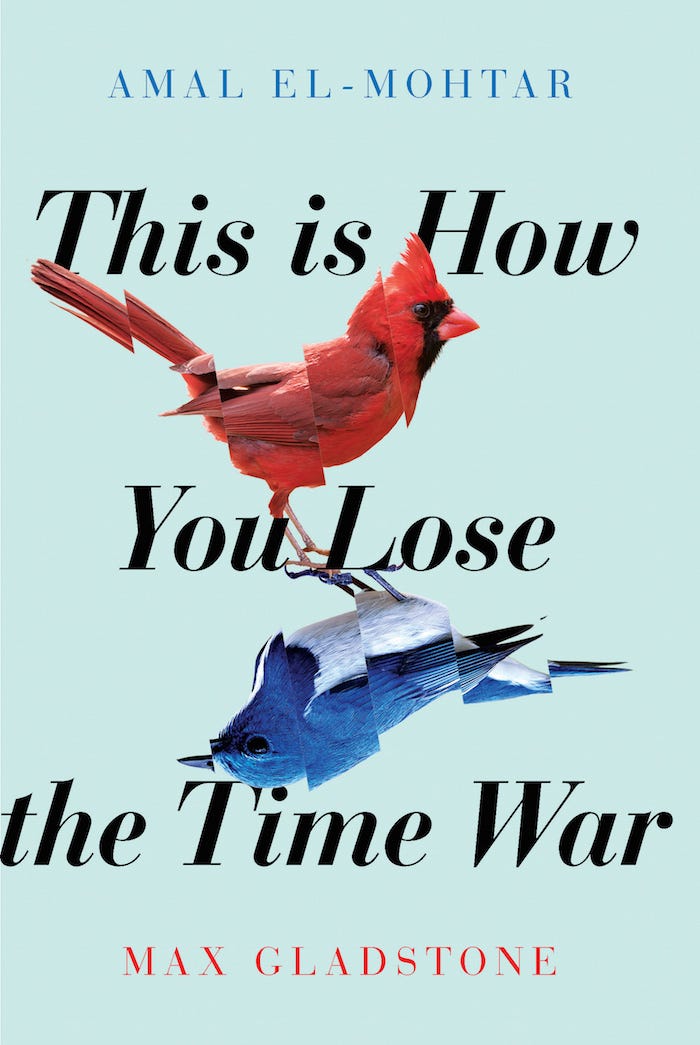
A Review Essay of This Is How You Lose the Time War by Amal El-Mohtar and Max Gladstone.

‘When Red wins, she stands alone.’
Have you considered writing a science fiction novel using letters? Can a story be told through an exchange of messages between two enemies? This is what Amal El-Mohtar and Max Gladstone did in their novel This Is How You Lose the Time War.
What I really find fascinating about this novel is the going back and forth between events and letters. We get to see two characters in their own world, trying to survive, but we also get to see their relationship develop. Red and Blue are their names; they are enemies in a world where time can be easily manipulated. There are advanced technologies and what feels like magic. What is interesting is that we don’t get to know or see what exactly the world’s logic is. In other words, the authors present us with “soft magic” where we don’t fully understand the technical environment of the world or how time exactly works. This technique lets us interpret the world; it lets our imagination go wild.
You might wonder: this might be confusing, right? And in places, it definitely was. The storyline doesn’t feel like it follows a coherent start-to-end logic. It is more like a pile of events that are connected. However, the letters make complete sense because they are written in a poetic, almost lyrical language, which is really surprising for a sci-fi novel. Look at this example: ‘I must tell you it gives me great pleasure to think of you reading these words in licks and whorls of flame, your eyes unable to work backwards, unable to keep the letters on a page; instead you must absorb them, admit them into your memory. In order to recall them you must seek my presence in your thoughts, tangled among them like sunlight in water.’ Notice the poetic language and metaphor? This makes their letters flow, which works well as this story has an enemies-to-lovers trope (with zero spice).
However, this style made it stand out for me. It doesn’t follow the chronological order of other sci-fi books, which made it unique. I always advise writers to try and experiment with techniques until they find the one that they enjoy writing. You don’t have to follow a standard writing style. Experimentation is what makes you discover your own voice and story. Don’t let rules guide you; you guide them until you find your story and your writing voice.
Another interesting aspect of this novel is the way each of them receives her letter (I should note that both main characters are women). They don’t read them from pages; they mostly receive them in the strangest ways. Look at this example: ‘she lingers by the MRI machine, musing as she does on the agonies of symmetry recording the water’s randomness—the magnetic bones settled like reading glasses on the thermodynamic face of the universe, registering each bloom and burst of molecule before it transforms. Once it translates the last of the water’s heat into numbers, she takes the printout in her right hand and fits the key of it into the lock of the letter-strewn sheet in her left.’
This is a brilliant idea and very creative. The authors created a unique way for each letter to be received by the other (in a liquid, inside the rings of a tree, and many other ways). However, sometimes it becomes illogical and abstract. Look at this example: ‘A rush of wind splits the earth, a roar in darkness. Red clutches the petrified trunk closer than a lover. The wind peaks, screams, tosses bones about. A new note rises above the ossuary clatter, woken by the cavern’s wind whistling over precise fluted pits in the bones Red has hung. The note grows, shifts, and swells into a voice.’ I am not sure how Red received this letter; was it in the wind? In the bones? The trunk? (It is more likely in the wind, but it is not clear because the previous paragraph was about the bones and how Red hung them on the tree). There is no logical explanation of what is happening, which makes it hard to follow and understand.
Another observation is that the writing becomes too lyrical sometimes. I have praised this technique in the previous section, especially in the letters. However, it gets annoying in the narrative sections. The authors use third-person narrative in these parts. Therefore, too many metaphors, similes, and emotions make it hard to read as a science fiction novel. I believe if the authors considered using poetic language in the letters themselves and using a more direct writing technique in the events, it would have been much more enjoyable. In many places, I couldn’t understand what was happening. Some events were not even clear (like the example mentioned above), which is why I gave the novel a lower rating than it might otherwise deserve.
Therefore, should you read This Is How You Lose the Time War? Is it worth your time? I say if you enjoy queer sci-fi, poetic language, literary storytelling, and fragmented narrative, you will truly enjoy reading this novel.
My rating for This Is How You Lose the Time War is: 3 Stars.
P.S: The ending of this novel is particularly good; it brings back the sci-fi elements where time is the main theme. However, some might consider this novel a love story, but I think it goes beyond that into a chaotic and poetic world.
Cool! Love the ratings too.
Fabulous review! I read this when it first came out and really enjoyed the writing. I'm a sucker for the lyrical--but also agree that it can slow the narrative down. This one deserves a re-read.